VetKeys
VetKeys (verifiably encrypted threshold keys) give canisters the ability to derive secret key material on demand, without any node or canister ever seeing the raw key. The protocol that underpins this capability is called vetKD: verifiable encrypted threshold key derivation.
The core problem vetKeys solve: encrypting data and storing it on the network is easy when the secret key stays on one device. The difficulty arises when a user needs to access that data from another device, share it with someone else, or let a canister participate in encryption workflows. Transmitting key material over public channels or storing it in a canister exposes it. VetKeys eliminate that exposure by making keys derivable from the network itself, encrypted for delivery, and verifiable by the recipient.
The vetKD properties
Section titled “The vetKD properties”The name describes how keys are derived:
- Verifiable. Recipients can verify that the key they received is correct and has not been tampered with. No trust in any individual node is required.
- Encrypted. Each derived key is encrypted under a client-supplied transport public key before it leaves the subnet. No node or canister ever sees the raw derived key.
- Threshold. Key derivation requires a quorum of subnet nodes to cooperate. No single node can derive the key on its own.
- Keys. The output is raw cryptographic key material that can be used for symmetric encryption, identity-based encryption, BLS signatures, or further key derivation.
How the protocol works
Section titled “How the protocol works”Every canister that uses vetKeys interacts with the subnet’s threshold key derivation infrastructure through two management canister methods: vetkd_public_key and vetkd_derive_key.
A key is derived from three inputs:
- Canister ID. Keys are scoped per canister. A key derived by one canister cannot be used as a key derived by another.
- Context. A developer-chosen domain separator (for example,
b"my_app_v1"). Context isolates subkeys per feature or use case within the same canister. - Input. An application-defined identifier for the specific key (for example, a user’s principal, a document ID, or a room ID).
The derivation is deterministic: the same (canister, context, input) triple always produces the same key. Keys do not need to be stored anywhere; they can be retrieved on demand by any client that can authenticate to the canister.
When a canister calls vetkd_derive_key:
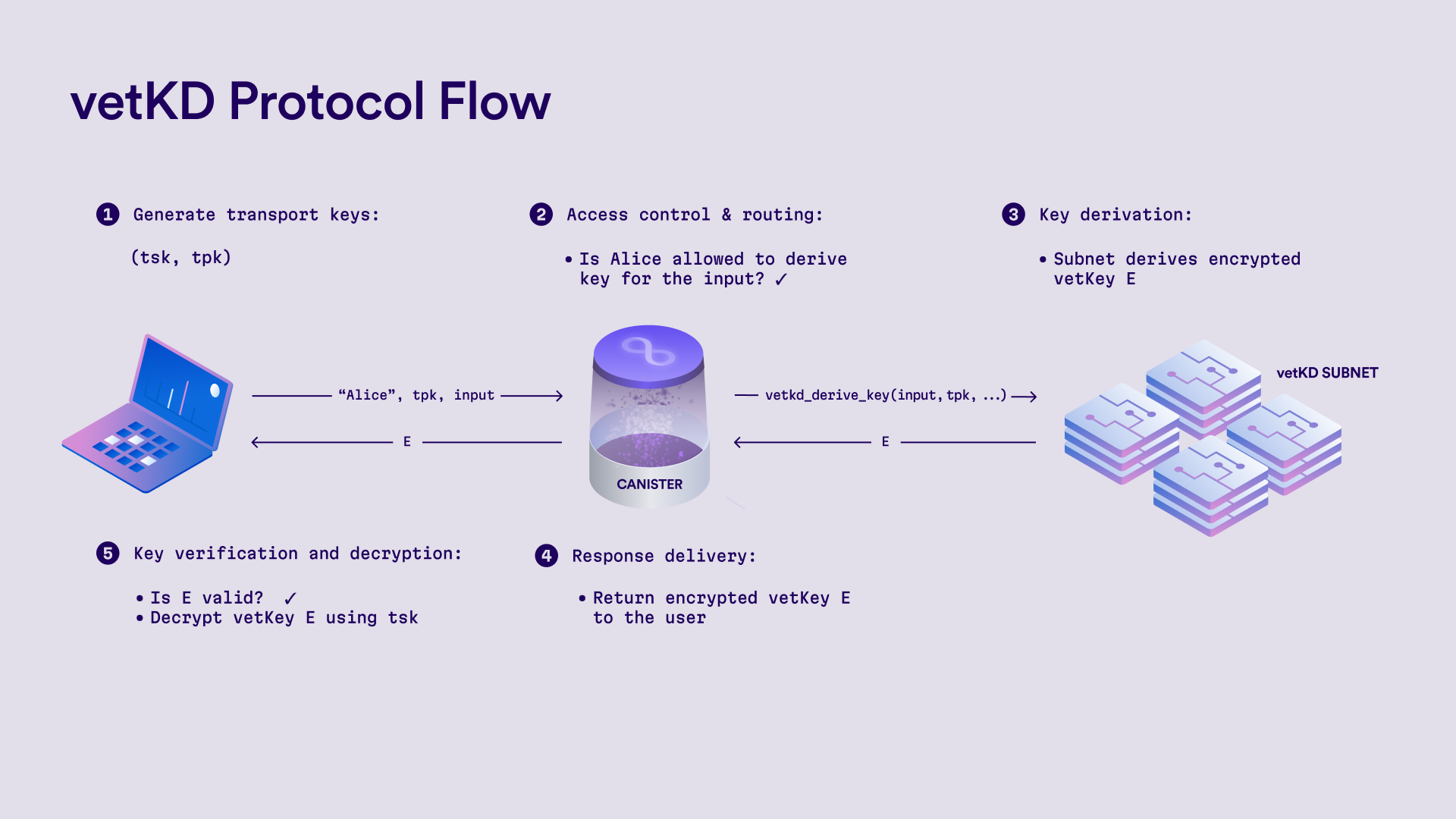
- The canister passes the
input,context,transport_public_key, andkey_idto the management canister. - A threshold of subnet nodes cooperates to derive the key and encrypt it under the supplied transport public key.
- The encrypted key is returned to the canister, which forwards it to the client.
- The client decrypts the key using its transport secret key, obtaining the raw vetKey locally.
The client’s transport key pair is ephemeral: generated fresh for each session and discarded after use. No node, no subnet, and no canister ever holds the client’s raw derived key.
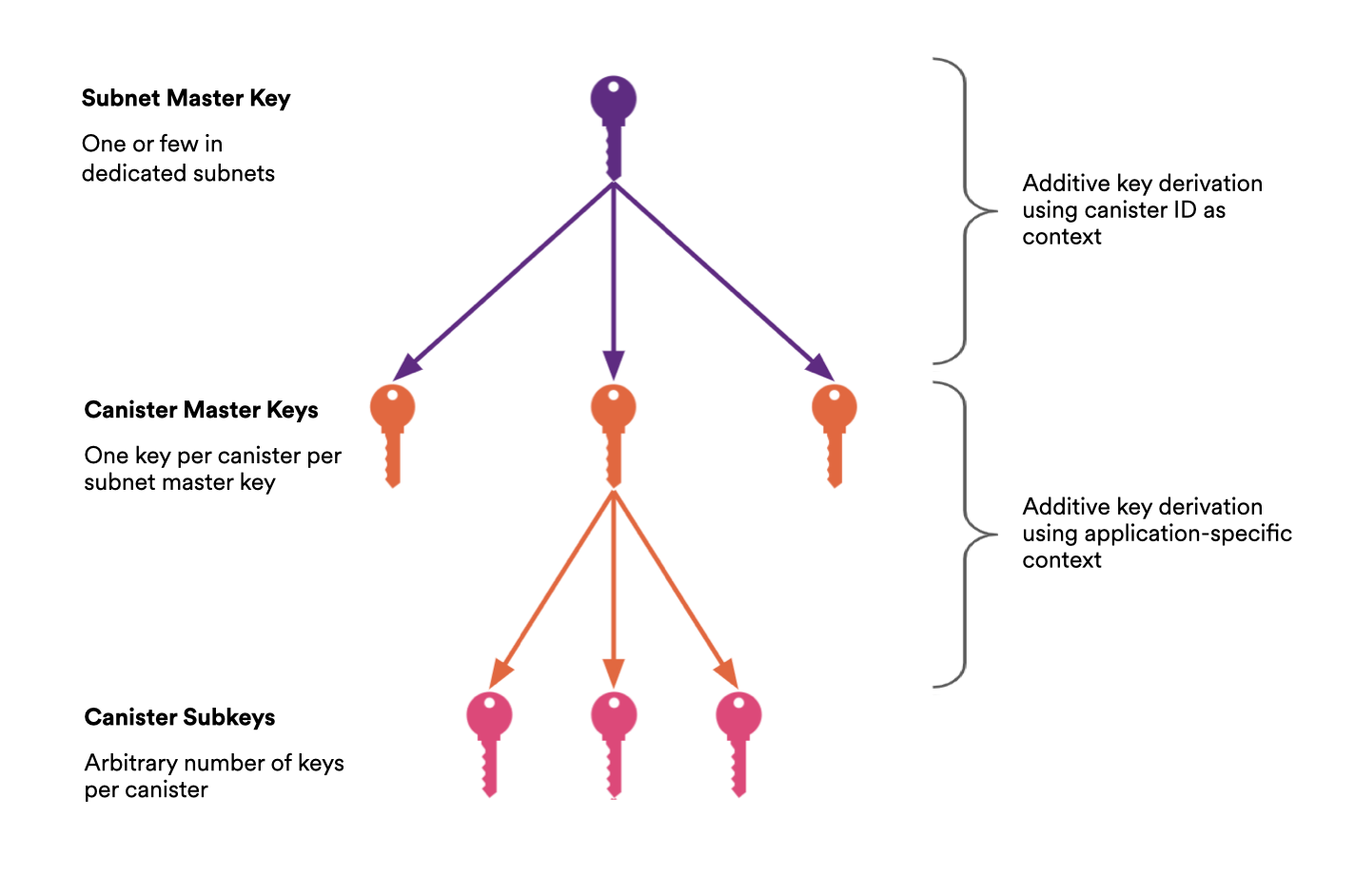
Keys are structured hierarchically. The subnet’s vetKD master key is used to derive a unique canister-level key for each canister, which in turn derives per-context and per-input subkeys:
API overview
Section titled “API overview”The vetKD API is exposed through two management canister methods:
vetkd_public_key : (record {  canister_id : opt canister_id;  context     : blob;  key_id      : record { curve : vetkd_curve; name : text };}) -> (record { public_key : blob });
vetkd_derive_key : (record {  input                : blob;  context              : blob;  transport_public_key : blob;  key_id               : record { curve : vetkd_curve; name : text };}) -> (record { encrypted_key : blob });
The only supported curve is bls12_381_g2. Two key names are available:
| Key name | Environment | Purpose | Cycle cost (approx.) |
|---|---|---|---|
test_key_1 | Local + mainnet | Development and testing | 10,000,000,000 |
key_1 | Mainnet only | Production | 26,153,846,153 |
vetkd_public_key carries no cycle cost. vetkd_derive_key consumes cycles at the rates above. If a canister may be blackholed or called by other canisters, send more cycles than the advertised cost: unused cycles are refunded, and this ensures calls succeed if the subnet grows in size. See Cycle costs for USD equivalents and full details.
Use cases
Section titled “Use cases”Encrypted storage
Section titled “Encrypted storage”A canister derives a symmetric encryption key for each user or resource using a unique input (a principal or document ID). The client encrypts data with this key before storing it in the canister. Only the client, and anyone the canister grants access to, can later obtain the decryption key. The EncryptedMaps library in ic-vetkeys and @dfinity/vetkeys provides a ready-to-use implementation of this pattern.
Distributed key management (DKMS)
Section titled “Distributed key management (DKMS)”Because key derivation is deterministic, a user can retrieve the same key from any device by authenticating to the canister. Canisters can grant access to other users by updating an access control list, enabling collaborative encrypted storage without peer-to-peer key exchange.
Identity-based encryption (IBE)
Section titled “Identity-based encryption (IBE)”Anyone can encrypt a message to a principal without the recipient being online or having pre-registered a key. The sender derives the recipient’s public key from the canister’s master public key and the recipient’s principal. The recipient later authenticates to obtain their corresponding vetKey and decrypts. IBE is an asymmetric scheme: any party can encrypt to an identity, but only the holder of that identity can decrypt.
Timelock encryption
Section titled “Timelock encryption”A variant of IBE where the canister controls when a decryption key becomes available. A sender encrypts to a future timestamp or batch identifier; the canister releases the corresponding vetKey only after the specified time or condition is met. Applications include secret-bid auctions, delayed-reveal content, and protection against maximal extractable value (MEV) on decentralized exchanges.
Threshold BLS signatures
Section titled “Threshold BLS signatures”VetKeys introduce threshold BLS signatures to canisters. BLS signatures are compact and support efficient aggregation, making them well-suited for multi-chain protocols and applications that need to verify many signatures efficiently.
Verifiable randomness
Section titled “Verifiable randomness”VetKeys can function as a verifiable random function (VRF): each (canister, context, input) triple produces a unique, unpredictable value that anyone can verify was correctly derived. This is useful for lotteries, games, and NFT trait assignment where outcomes must be demonstrably fair.
Current status
Section titled “Current status”The vetKD management canister API is live on mainnet. The ic-vetkeys Rust crate (v0.6) and @dfinity/vetkeys npm package (v0.4.0) provide higher-level abstractions over the raw API. Pin your dependency versions and consult the DFINITY forum for any migration guides after upgrades.
Next steps
Section titled “Next steps”- Chain-Key Cryptography: the threshold cryptographic foundation that vetKeys build on
- Security model: canister memory confidentiality and why vetKeys help