Canisters
Canisters are the compute units of the Internet Computer. Each canister bundles compiled WebAssembly code with its own persistent state into a single unit that the network executes, replicates, and secures. You deploy code to a canister, send it messages, and the network guarantees that every honest node in the subnet reaches the same result.
Unlike programs on most other blockchains, canisters can serve web pages over HTTP, store gigabytes of data, make calls to external APIs, sign transactions on other chains, and run scheduled tasks autonomously, all without external infrastructure.
Execution model
Section titled “Execution model”Canisters are WebAssembly module instances. You write code in Motoko or Rust (the official CDKs), or community-supported languages like TypeScript and Python: any language that compiles to Wasm works. The network runs your code in a sandboxed Wasm virtual machine.
Each canister runs on a single thread. It processes messages one at a time in sequence, which means there are no data races within a canister. However, many canisters execute concurrently across (and within) subnets, so the network as a whole achieves high throughput.
Canisters follow the actor model: they maintain private state, receive messages, send messages to other canisters, and can create new canisters.
Message types
Section titled “Message types”All interaction with a canister happens through messages. There are two categories:
- Ingress messages: sent by external users (through a browser, CLI, or agent library).
- Inter-canister messages: sent from one canister to another within the network.
Ingress messages use one of two call types:
Update calls
Section titled “Update calls”Update calls can modify canister state. They go through consensus: every node in the subnet executes the call, and the subnet collectively signs the response. This provides strong authenticity guarantees: a single malicious node cannot forge results.
Update calls typically complete in 1–2 seconds. They cost cycles.
Query calls
Section titled “Query calls”Query calls read state without modifying it. A single node executes the call and returns the result directly, without consensus. Because the response is not threshold-signed by the subnet, query results should be treated as unverified unless you use certified variables. The tradeoff is speed: results come back in milliseconds.
For applications that need authenticated reads (for example, a governance app showing proposal text that a user will vote on), you have two options:
- Issue the query as an update call for full consensus, at the cost of higher latency.
- Use certified variables to pre-sign data during updates and serve proofs in query responses.
Composite queries
Section titled “Composite queries”Composite queries let a query call other queries on canisters within the same subnet, then combine the results into a single response, all without going through consensus. This is useful for aggregating data across multiple canisters at query speed.
Key constraints:
- Same subnet only: composite queries cannot call canisters on other subnets.
- Ingress only: only external clients (browsers, CLI tools) can invoke composite queries. Other canisters cannot call them.
- No replicated mode: unlike regular queries, composite queries cannot be executed as update calls for stronger authenticity.
A composite query can also call the management canister query methods canister_status, canister_metrics, canister_info, fetch_canister_logs, and list_canisters. These calls are answered from the state of the calling canister’s own subnet, so they can only target canisters on that subnet, and the calling canister must be permitted to read that data (for example, be a controller of the target canister). The exception is canister_info, which returns public data and is not subject to any access control.
Memory model
Section titled “Memory model”Each canister has two storage regions:
| Region | Max size | Persisted across upgrades | Access |
|---|---|---|---|
| Heap (Wasm) memory | 4 GiB (wasm32) / 6 GiB (wasm64) | No (cleared on upgrade, unless using Motoko’s orthogonal persistence) | Standard Wasm memory instructions |
| Stable memory | 500 GiB | Yes | System API calls |
Heap memory is standard Wasm linear memory. It holds your program’s heap-allocated data: variables, data structures, and anything your code allocates at runtime. Both 32-bit and 64-bit Wasm memory are supported. Heap memory is cleared when you upgrade the canister’s Wasm module.
Stable memory is a separate address space accessed through the system API. It survives upgrades, making it the right place for any data that must persist long-term. Libraries like StableBTreeMap (Rust) or the core persistent data structures (Motoko) let you work with stable memory through familiar abstractions.
After a message executes successfully, the system atomically commits all memory changes. If execution traps (fails), no changes are committed. The canister’s state rolls back to what it was before that message.
For a deeper dive, see Orthogonal persistence.
Canister IDs and principals
Section titled “Canister IDs and principals”Every canister gets a globally unique canister ID when it is created. This ID is a principal: the same type of identifier used for users, and serves as the canister’s address on the network.
To send a message to a canister, you include its canister ID in the message header. The network routes the message to the correct subnet and places it in the canister’s input queue for processing.
Canister IDs look like ryjl3-tyaaa-aaaaa-aaaba-cai. You can see them in icp.yaml after deploying, or look them up on the ICP Dashboard.
Canister lifecycle
Section titled “Canister lifecycle”A canister goes through four lifecycle stages:
Create
Section titled “Create”Creating a canister allocates a canister ID and reserves resources on a subnet. At this point the canister exists but has no code.
Install
Section titled “Install”Installing uploads a Wasm module to the canister and runs its initialization logic. After installation, the canister is running and accepting messages.
Upgrade
Section titled “Upgrade”Upgrading replaces the canister’s Wasm module while preserving stable memory. The runtime executes three steps atomically:
pre_upgrade(orsystem func preupgradein Motoko): save any heap data to stable memory before the code swap.- New Wasm module is installed.
post_upgrade(orsystem func postupgrade): read data back from stable memory into the new heap layout.
If pre_upgrade traps, the upgrade is aborted and the canister continues running the old code. If post_upgrade traps, the new code is installed but the canister is left in a failed state. If a canister ensures all persistent data is always in stable memory, steps 1 and 3 can be left empty.
Stop and delete
Section titled “Stop and delete”Stopping a canister prevents it from accepting new messages while letting in-flight messages complete. Once stopped, a canister can be deleted to reclaim its resources and remaining cycles.
For step-by-step CLI commands, see Canister lifecycle management.
Controllers
Section titled “Controllers”Controllers are principals (users or other canisters) that have permission to manage a canister: upgrade its code, change its settings, stop it, or delete it.
The control structure can take several forms:
| Control structure | Who is the controller | Effect |
|---|---|---|
| Centralized | A single developer’s principal | Full developer control; standard during development |
| Multi-signature | A multi-signer wallet like Orbit | Requires multiple keys to approve any change |
| SNS-governed | A Service Nervous System (SNS) governance canister | Upgrades require a governance proposal voted on by asset holders |
| No controller | Empty controller list | Immutable canister; code can never be changed |
If a canister has no controllers, it is immutable: no one can change its code or settings. This is a strong trust guarantee for users. Immutability can be verified on the ICP Dashboard.
Canister internals
Section titled “Canister internals”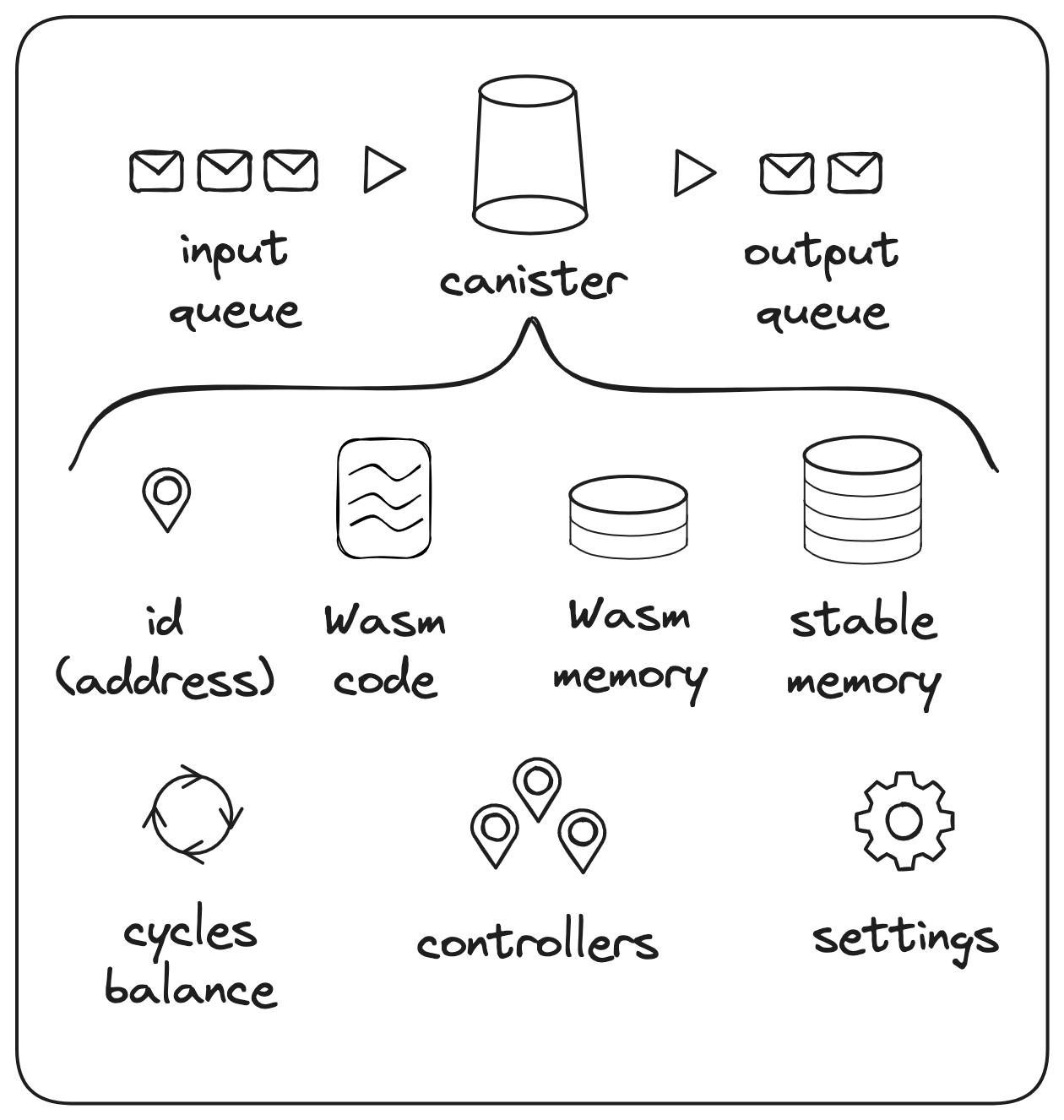
Under the hood, each canister maintains several components:
- Input queue: holds incoming messages waiting to be processed. The canister processes one message at a time.
- Output queue: holds outgoing messages to other canisters, dispatched after successful execution.
- Cycles balance: the canister’s fuel for computation and storage. The system deducts cycles after each message execution, whether it succeeds or fails.
- Controllers list: the set of principals authorized to manage the canister.
- Settings: configurable parameters like compute allocation, memory allocation, and the freezing threshold (the cycles balance below which the canister stops accepting new messages to avoid running out).
Inter-canister messaging and error handling
Section titled “Inter-canister messaging and error handling”Canisters communicate by sending requests to other canisters and registering a callback to be invoked when the callee sends a response. The network guarantees that every request receives a reply: if a callee becomes unreachable or explicitly rejects a call, the Internet Computer synthesizes a reject response and delivers it to the caller’s callback. Callbacks are never dropped.
This bidirectional request/reply model is one way canisters differ from pure actors in classical actor-based systems, which typically use one-way fire-and-forget messages.
Trap behavior with outgoing calls: When a canister processes a message, it may send outgoing requests before completing. Each time a canister sends a request, the network records a commit point. If the canister later traps while awaiting a response, its state reverts to what it was immediately after that last outgoing request was dispatched, not to the beginning of the original incoming message. This means any state changes made after the last outgoing call are rolled back, while changes made before it are preserved.
This has a practical implication: if a canister modifies state and then makes an inter-canister call in the same message, it must account for the possibility that subsequent code (including the callback handler) will see the state as it was when the call was sent.
Next steps
Section titled “Next steps”- Cycles: how canisters pay for computation
- Principals: the identity model and caller authentication
- App architecture: how canisters fit into application design
- Canister lifecycle: practical guide to managing canisters
- Network overview: the infrastructure canisters run on